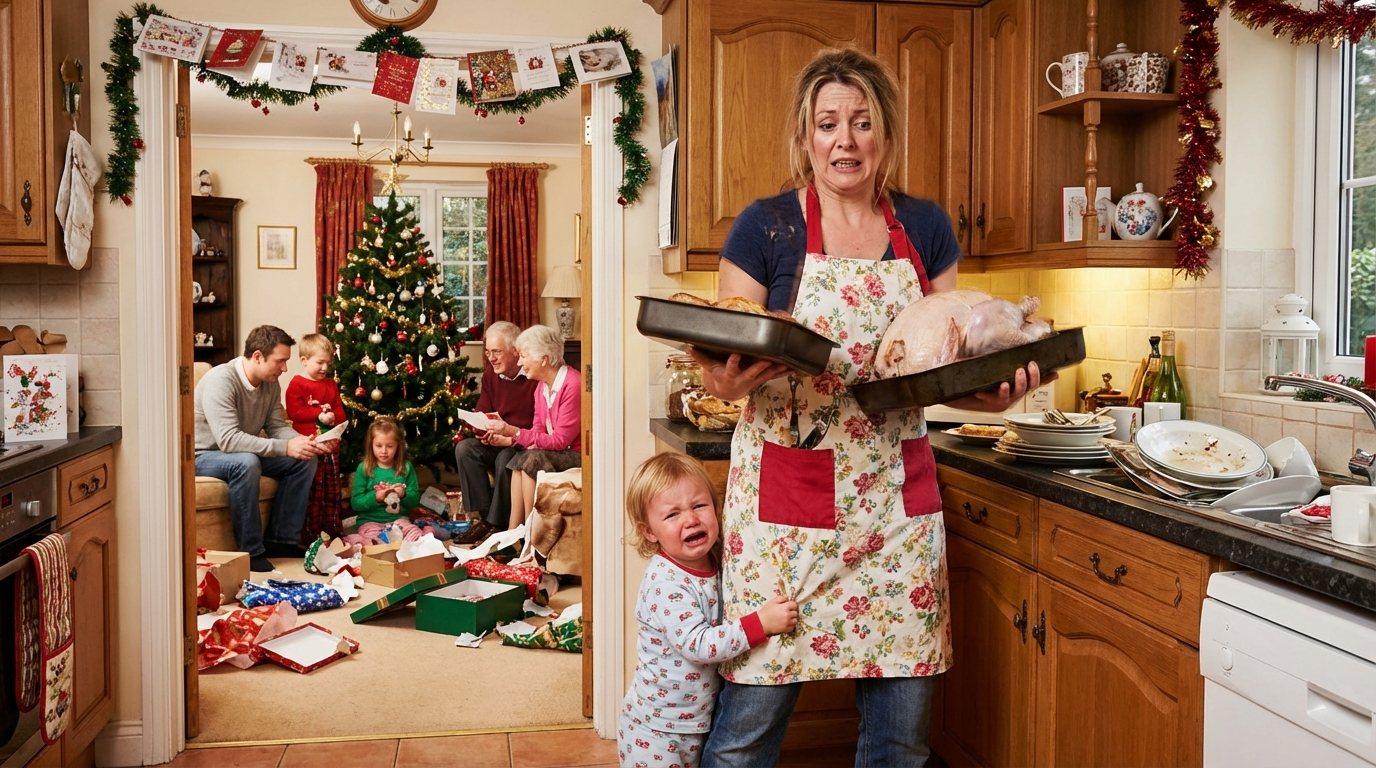
I love Christmas. I also find it exhausting. I remember as a child being sick every Christmas.. If like me you ever wondered why the “most wonderful time of the year” leaves you feeling drained, irritable, or sick, the answer lies in your nervous system.
Let me explain what’s really happening in your brain and body during the holidays, and what you can do about it.
Your Brain on Holiday Mode
Your nervous system runs on patterns. It thrives on predictability. This isn’t being rigid or boring, it’s how your brain conserves energy for the things that matter.
Christmas disrupts nearly every pattern you have built over the year.
You’re eating different foods at different times. Rich meals replace your usual lunch. You’re snacking more. Your blood sugar swings wildly from chocolate to turkey to more chocolate. You’re drinking more alcohol, more coffee, or both.
You’re sleeping less or at odd hours. Late nights wrapping presents. Early mornings with excited children. Interrupted sleep because you’re mentally running through tomorrow’s to-do list.
Your routine is gone. No morning walk because you’re rushing to get things done. No regular gym session. No quiet evening because there’s a party to attend.
You’re in crowded shops with harsh lighting and loud music. You’re at social gatherings making conversation when you’d rather be home. You’re navigating family dynamics that require careful attention.
You’re managing expectations from everyone. Your children want magic. Your parents want tradition. Your partner wants help. Your boss wants everything finished before the break. You want it all to be perfect.
Each disruption requires your brain to process more information. Each decision – even small ones like “which wrapping paper?” or “should I make mince pies or buy them?” – uses mental energy. Each social interaction requires you to read faces, respond appropriately, and regulate your own emotions.
This adds up fast.
The Stress Response You Don’t Notice
Your autonomic nervous system has two main modes: rest-and-digest (parasympathetic) and fight-or-flight (sympathetic).
In rest-and-digest mode, your body heals itself. It digests food properly. It fights infections. It processes emotions. It consolidates memories. You feel calm and capable.
In fight-or-flight mode, your body prepares for immediate action. Your heart rate increases. Your muscles tense. Your digestion slows. Your immune system takes a back seat. Energy is diverted from long-term health to short-term survival.
During Christmas, you shift into fight-or-flight mode more often than you realize. Not because you’re in actual danger, but because your brain interprets the constant demands as threats to your wellbeing.
Tight deadlines at work before the break trigger stress hormones. Traffic jams getting to the shops trigger stress hormones. Worry about money triggers stress hormones. Concern about family arguments triggers stress hormones. Running late triggers stress hormones.
Even positive excitement triggers the same physiological response. Anticipation of Christmas morning. Planning a surprise gift. Hosting dinner for twelve people. Your body can’t tell the difference between good stress and bad stress. It just responds.
The problem isn’t one big stress. It’s twenty small ones every day for three or four weeks. Your nervous system never gets a chance to return to baseline. You’re running on adrenaline and cortisol, and it feels normal because everyone around you is doing the same thing.
Then January arrives and you crash. You get sick. You feel depressed. You wonder why you can’t enjoy the holiday you worked so hard to create.
The Physical Signs Your Nervous System Is Struggling
Your body gives you clear signals when your nervous system is overwhelmed. Most people ignore them or push through.
- Headaches and migraines. Tension builds in your neck and shoulders. Your jaw clenches. Blood flow to your brain changes. The pain is your nervous system saying it needs a break.
- Digestive problems. Bloating, constipation, or loose stools aren’t just about rich food. When you’re in fight-or-flight mode, your digestion shuts down. You’re not absorbing nutrients properly. Your gut bacteria change. This affects your mood, your energy, and your immune system.
- Sleep problems. You’re tired but you can’t fall asleep. Or you fall asleep but wake at 3am with your mind racing. Your nervous system is stuck in alert mode. It can’t switch off even when you need it to.
- Getting sick. Colds, flu, cold sores, or infections always seem to strike during or right after Christmas. This happens because chronic stress suppresses your immune system. The viruses were always there. Your body just lost the ability to fight them off.
- Mood changes. You snap at your children over small things. You feel tearful for no clear reason. You feel irritable or anxious. These aren’t character flaws. They’re signs that your nervous system is depleted.
- Pain. Your back hurts more. Your old injury flares up. Everything aches. Pain and stress feed each other in a loop that’s hard to break.
Why Children Struggle Too
Children’s nervous systems are still developing. They’re even more sensitive to disruption than adults.
Late nights affect their sleep patterns. Children need more sleep than adults because their brains are growing and processing enormous amounts of new information every day. Even one late night can throw them off for several days.
Sugar affects their blood sugar regulation. Children’s bodies are still learning to manage glucose. The constant supply of sweets, chocolate, and special treats causes energy spikes and crashes that their system can’t handle smoothly.
Excitement affects their ability to settle. Anticipation is a powerful emotion. For children who don’t yet have the brain development to manage big feelings, the build-up to Christmas can be genuinely overwhelming.
Changes in routine affect their sense of safety. Children rely on routine to feel secure. When everything is different – different bedtimes, different food, different activities, visitors in their space – they lose their anchor points.
Screen time increases. Tablets and TVs at relatives’ houses. Films as treats. Games to keep them occupied while you cook. All of this overstimulates their developing nervous system and makes it harder for them to regulate themselves.
This is why children often have meltdowns during the holidays, even when everything seems fun. Their nervous system is overwhelmed. They’re not being naughty. They’re not being ungrateful. They’re dysregulated, and they need help getting back to calm.
The crying over a broken biscuit isn’t about the biscuit. It’s about a nervous system that’s been pushed past its capacity.
The Parent’s Nervous System: A Special Challenge
If you’re a parent, you’re managing your own overwhelmed nervous system while trying to regulate everyone else’s.
You’re the one making sure the magic happens. Shopping, wrapping, cooking, organizing, remembering, planning. You’re responding to your children’s dysregulation with patience you don’t feel. You’re mediating family dynamics. You’re keeping track of a hundred small details.
Your nervous system is doing the work of several people. And unlike your children, you don’t get to have a meltdown. You have to hold it together.
This is why so many parents feel on the edge of burnout by Christmas Day. You’ve been operating in crisis mode for weeks. Your nervous system has nothing left to give.

What Actually Helps: The Science of Recovery
Your nervous system needs three fundamental things during this period:
Sleep – The Non-Negotiable
Sleep is when your brain processes stress. During deep sleep, your brain literally washes away the toxic proteins that build up during the day. It consolidates memories and learning. It regulates your emotions.
When you skip sleep, your brain can’t do this essential maintenance. The stress chemicals stay in your system. Your emotional regulation fails. Your decision-making suffers. Everything feels harder because it genuinely is harder for a sleep-deprived brain.
You need seven to nine hours. Not “I’ll catch up later.” Not “I’ll sleep in January.” Your brain needs it now, consistently.
For children, the amount is even more critical. Toddlers need 11-14 hours. School-age children need 9-11 hours. Teenagers need 8-10 hours. This isn’t optional. Their brain development depends on it.
Movement – The Stress Release Valve
Your body releases stress through movement. When you’re in fight-or-flight mode, your muscles are primed for action. If that action never comes, the stress hormones stay in your system.
Walking, running, dancing, playing with your children – all of these help your body complete the stress response cycle. A 20-minute walk does more for your nervous system than an hour of sitting and worrying.
Movement also stimulates your vagus nerve, the main nerve of your parasympathetic (rest-and-digest) system. This helps shift you out of fight-or-flight mode.
You don’t need to go to the gym. You don’t need special equipment. You just need to move your body every day.
Quiet Time – The Reset Button
Your nervous system needs periods of genuine rest. Not scrolling your phone. Not watching TV. Not planning or organizing in your head.
Just sitting. Breathing. Letting your mind wander. Looking out a window. Lying on the floor.
Even 10 minutes of this helps your brain switch out of fight-or-flight mode. It activates your prefrontal cortex, the part of your brain that helps you think clearly and make good decisions. It gives your system permission to stand down from high alert.
This feels impossible during Christmas. It feels indulgent. But it’s as necessary as sleep. Your brain cannot function well without it.
The Chiropractic Connection: How Your Spine Affects Stress
Your spine houses your spinal cord, the main highway of your nervous system. Every signal between your brain and body travels through here.
When your spine isn’t moving properly, when joints are restricted or muscles are tight, it sends stress signals to your brain. Not pain necessarily, but information that something isn’t right. Your brain has to process these signals along with everything else.
During Christmas, your spine takes a beating. You’re sitting more (long car journeys, dinner tables, wrapping presents on the floor). You’re lifting more (shopping bags, children, luggage). You’re sleeping in strange beds. You’re holding tension in your shoulders and neck.
All of this creates more noise in your nervous system at the exact time when it’s already overwhelmed.
Here’s where the research gets interesting. Studies from our research group have shown that chiropractic adjustments don’t just affect your spine. They affect how your brain processes information.
Adjustments activate your prefrontal cortex , the part of your brain responsible for decision-making, emotional regulation, and stress management. They reduce activity in the parts of your brain that process pain and threat. They improve the accuracy of your body’s internal map of itself, which helps you move better and feel safer in your body.
In practical terms, this means adjustments help your brain adapt to stress more effectively. They don’t eliminate the stressors, but they improve your nervous system’s ability to cope with them.
For children, this is even more significant. Their nervous systems are actively developing. The input they receive shapes how their brain organizes itself. Regular adjustments during periods of high stress can support healthy nervous system development.
A Different Approach This Year
You can’t eliminate holiday stress. Your family still has expectations. Work still has deadlines. The shops are still crowded.
But you can reduce how much it affects your nervous system. And you can help your children’s nervous systems cope better too.
Say no to some invitations. Your nervous system needs space more than it needs another party. Choose the gatherings that genuinely matter to you.
Buy less. Every purchase requires decisions. Every gift requires mental energy to choose, buy, wrap, and deliver. Fewer, more thoughtful gifts create less stress for you and often more meaning for the recipient.
Do less. Not every tradition needs to happen. Not every surface needs decorating. Not every meal needs to be elaborate. Let some things be simple. Let some things be imperfect.
Protect sleep. Make this the priority it deserves to be. Say no to late events if they’ll cost you sleep. Get your children to bed at reasonable times, even on special occasions. The magic of Christmas depends on regulated nervous systems, and regulated nervous systems depend on sleep.
Move every day. A family walk after dinner. Dancing in the kitchen. Playing in the park. Make movement a non-negotiable part of each day.
Book your adjustments. We see the difference in our practice every year. Families who come in regularly through December cope better. Parents are calmer. Children are less reactive. Everyone reports getting through the season with more ease.
Your nervous system is doing its best to keep you safe, healthy, and functioning during a genuinely demanding period. Give it the support it needs.
You might not achieve the perfect Christmas. But you might actually enjoy the imperfect one you create. And in January, you might still have energy left.
That would be the real gift.
We know how demanding this season is for families. We’re here to support your nervous system through it. Book your appointments now – we get busy in the three weeks before Christmas, and we want to make sure we can see you when you need us most.
Contact Northcote Chiropractic today to start your journey to better spinal health.